Author. Artist. Survivor. Builder.
Children's homes. Detention centers. Juvenile prisons. These are not words from a book Morris Jackson read — they are the addresses of his childhood. He moved through the system like cargo. Processed. Transferred. Filed away.
There was no guidance. No stable hand. No one standing at the door saying "I see you. I've got you." The adults who were supposed to protect him were the walls of institutions, not people who knew his name.
He was a child. He needed someone to come. No one came.
That child — moved like cargo, warehoused instead of raised — grew up to build a platform for everyone the world also decided to warehouse. That's not irony. That's mission.
At fourteen years old, Morris Jackson was shot with a twelve gauge. Downtown. In front of the public library.
Read that again slowly.
A child. Fourteen years old. Standing in front of a library — a place built for learning, for becoming, for futures — and a twelve-gauge shotgun ended his sense of safety in this world.
He was not the shooter. He was the one who got shot. He was the victim. There was no safe place to go. The streets didn't have exits. The institution doors had already swung shut behind him. And the world he was born into didn't have a category for kids like him except at risk — meaning the risk was always on him, never on the system that abandoned him first.
He survived. That survival — bloody, scarred, without ceremony — is where the testimony begins. Not the clean version. The real one.
They arrested him. They convicted him. The sentence: 32 years.
No evidence. Miranda rights violated. An all-white jury. A conviction built on nothing but the willingness of a system to consume a Black man and call it justice. This was not a hard case. This was not a close call. This was a wrongful imprisonment — 20 years stolen from a man's life because the people in charge decided it was easier to cage him than to find the truth.
Twenty years. Think about what happens in twenty years. You age. Your family ages. Funerals happen. Children are born. The world moves and you are frozen in a cage while it does. The people who locked you up go home every night. You don't.
This is the America that Morris Jackson lived inside. Not the America on the poster. The real one.
Three resentencings. Two remands.
From inside a cage, Morris Jackson fought. Not with violence — with law, with language, with the insistence that he existed and that his life mattered and that the truth had not yet been told in full.
Most people break. Not as a weakness — as a survival mechanism. The weight of wrongful imprisonment is designed to crush the belief that you deserve freedom. It asks you, every single day: Why keep fighting? No one is listening. No one cares. Give up.
He didn't give up. He fought for justice that should have been automatic. He demanded that the system answer for what it did. And eventually — slowly, grindingly — it had to.
The door opened.
After 20 years. After everything the system took and tried to keep. After children's homes and a bullet in front of a library and a conviction built on nothing and two decades inside a cage — Morris Jackson walked out.
Freedom after that long doesn't look the way people imagine it. It isn't confetti. It's overwhelming. The world you left has been replaced by one you don't recognize. Everyone you knew has scars you weren't there for. There is no welcome home parade for people the system wrongfully imprisoned. They simply... release you. And you stand there.
He didn't walk away from the mission. He walked into it.
He could have disappeared. He earned it. Twenty years wrongfully imprisoned, a childhood swallowed by the system, a bullet in his body before he was old enough to vote — no one would blame him for taking his freedom and never looking back.
Instead, Morris Jackson sat down and built a healing platform for other people in crisis.
For the kids still in those homes, being moved like cargo. For the people still in those cells, fighting for a truth no one wants to hear. For anyone standing on the edge at 2am thinking the world is better off without them. For everyone the system decided didn't matter.
Mined Fruit is not a startup. It is not a content play. It is not a business seeking scale. It is a man who survived every reason not to care — and cared anyway. It is a testimony made into a platform. A life poured into a tool for the people who need it most.
My purpose is not my own. That's not a tagline. That's the entire explanation.
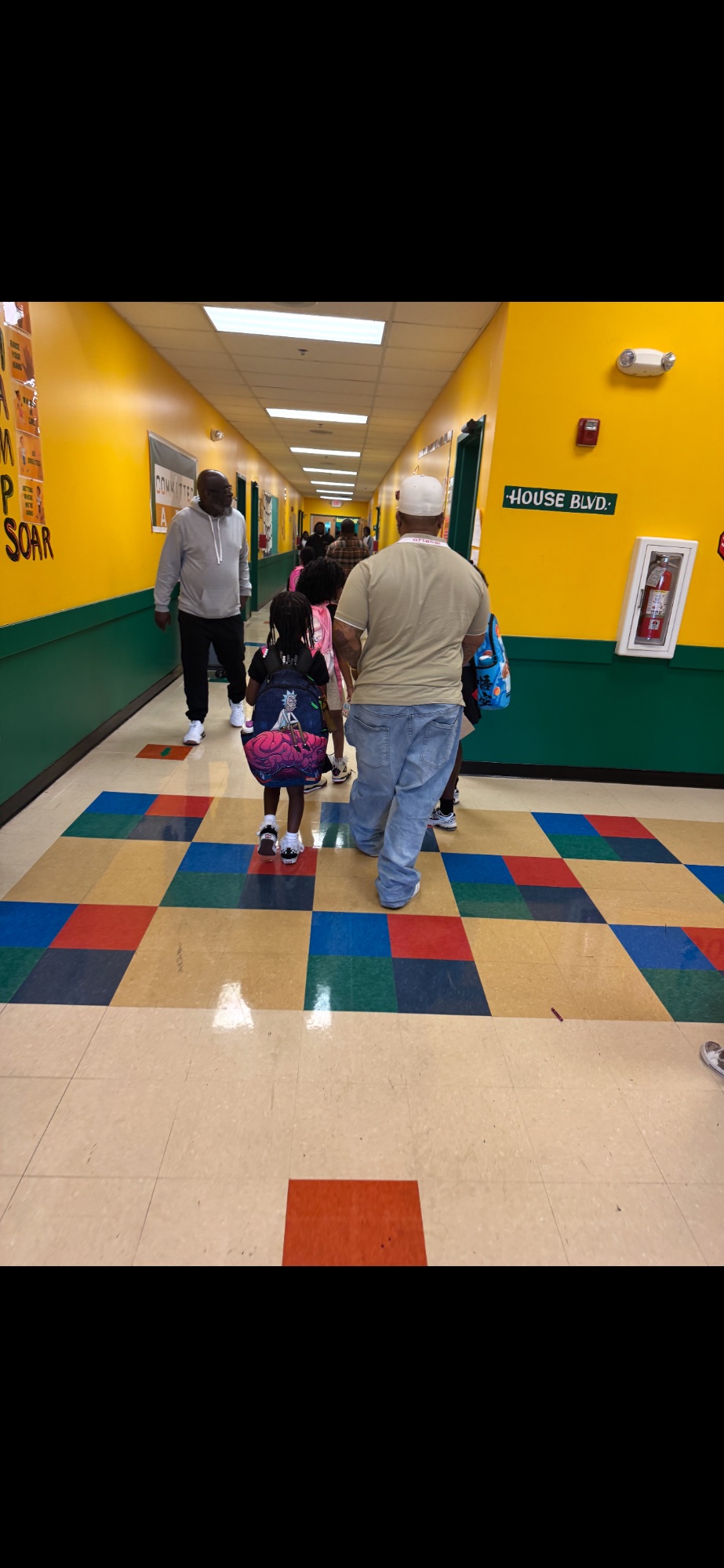
This is who's building this platform. A father. A man who gets up every morning and walks his children down a bright, colorful hallway — backpacks loaded, day beginning — before he sits down to write a single word of purpose or a single line of code.
He builds Mined Fruit for people like his own kids. For every child walking those halls who deserves a world that doesn't fail them when things get hard. For every parent who shows up. For every morning that proves: this man still believes in tomorrow.
Here is what people miss: Morris Jackson is formally trained in visual communication. The charcoal artwork in the Mined Fruit gallery — every piece — was drawn by the same hands that signed legal documents fighting for his freedom. The same hands that built this platform.
Each piece is named. Each piece has weight. You don't title a charcoal drawing "Driven" unless you know what it cost to stay that way. You don't draw "Silk Purpose" unless you've found yours.
A story about redemption, blood ties, and the cost of the streets. Written by Morris Jackson. Available now on Mined Fruit — because some truths can only be told as fiction first.
He is a published author. A poet. A builder. A visual artist. A man who spent 20 years wrongfully imprisoned and came out the other side with more to say than most people find in a lifetime of freedom.
The platform you're using right now — the jazz lounge that helps you breathe, the poetry that keeps someone alive tonight, the chat room with no judgment — it was designed by someone who earned every word of it.
This platform exists because one man survived things that would have ended most people,
and decided to use the survival as a service. Not for profit. Not for recognition.
For the kids still being moved like cargo. For the people fighting from inside cages
for justice that should have been automatic. For anyone who finds themselves at the edge
and needs to hear one true thing before they decide.
If you found this platform at 2am, if you're reading this when you thought no one gets it —
this man gets it. He built this for you, specifically.